

Book Review: Gladiators in the Greek World
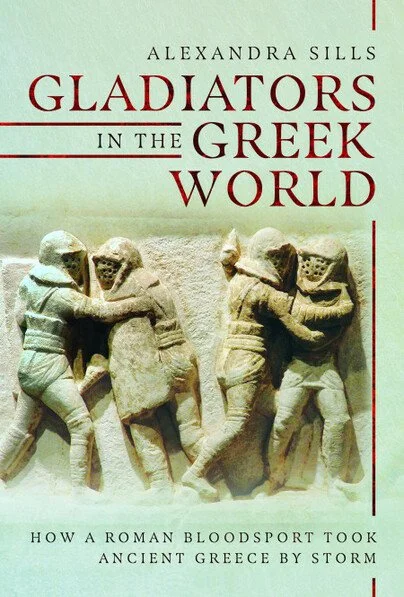
Gladiators weren’t a topic that I knew very much about, not for lack of interest, but because I had no idea of where to start. With Ridley Scott’s Gladiator films and a handful of superficial facts as my only frame of reference, it was clear that I had a very long way to go. Luckily for me, the perfect remedy to this came in the form of Alexandra Sills’ debut, Gladiators in the Greek World: How a Roman Blood Sport Took Ancient Greece by Storm.
I was first drawn to the book by its title, which both puzzled and intrigued me. I’d never seen or heard of gladiators being discussed in relation to Ancient Greece before, let alone imagined that gladiation could resonate with a non-Roman audience. Sills identifies this common misconception as resulting from our preconceived notion of the Ancient Greeks as a people who valued the pursuit of knowledge, and innovation above all else. An appreciation of and genuine demand for gladiator shows doesn’t sound at all in keeping with the image we typically hold of much of Greek society (all this despite what we know of their military history, Spartan warrior society, and recurring literary themes). The fact that there is still a degree of resistance to accepting this reality within the Classics sphere shows the need for this book.
Beyond that though, it’s also a means of remembering the individuals that we are so often guilty of overlooking: the ordinary people – those who became gladiators would have been slaves, freedmen, or freeborn indentured slaves – who may not have been able to create an enduring legacy or become the subject of countless studies, but who have nevertheless left their marks on the world.
In nineteen enlightening chapters, Sills explores the events and circumstances that led to the emergence of gladiators in Greek regions and the ways in which they subsequently made a Roman sport their own.
The amount of information covered is truly impressive, even more so because at no point was I left feeling overwhelmed or concerned that quantity was being prioritised over substance. If I really had to restrict myself to a couple of favourites – and believe me when I say that this was no easy feat – they would be the chapters about gladiators’ gravestones, the different types of gladiator and the lives that they led, and the artwork created in response to the sport’s increasing popularity. I was also interested to discover that the Moirai – more commonly known by English speakers as the Fates – were mentioned on several gladiators’ epitaphs as being the true cause of their demise.
Although it’s morbid to think about, this type of profession required a degree of acceptance where death was concerned. Knowing that their lives rested on their skills as well as the audience’s favour would spur them to put on as memorable of a performance as they could. Sills suggests that because gladiators took great pride in their achievements, it would make sense that they would use a preordained death to detract from what was otherwise the lowest point in their careers.
I was equally fascinated by the existence of what was essentially a gladiator fandom: countless pieces of memorabilia and artwork were produced for audience members to use and display as a testament of their love for the sport.
From terracotta lamps to gladiator action figures, it certainly looks like many wanted to bring a piece of the games home with them.
Gladiator graffiti too is reminiscent of modern expressions of appreciation made to celebrate our favourite pieces of media or hobbies. A fun example given by Sills is found in the Terrace Houses at Ephesus, where archaeologists have uncovered various gladiator doodles scratched into the plaster. This, she argues, shows that people were still thinking about what they had witnessed long after the event itself.
One of the book’s greatest strengths lies in Sills’ writing style. There is a conversational quality to the way that she explains things that makes you feel like an active participant in her investigation. Like a good friend telling you a particularly compelling story, her words brim with infectious enthusiasm. Chapter titles such as A Gangrene in the Greek World?, CSI Case Study: An ID to Last for All Eternity, and A Picture Paints a Thousand Wounds, lean into this aspect as well, which only makes the reading experience even more immersive. I always appreciate this kind of approach to non-fiction, as it can really make the difference between creating a book that’s accessible and one that makes the reader feel like they need an extensive background in the subject to so much as dip their toe into the material. Sills’ writing is approachable, the information she provides still pushing the reader to learn more, but never oversimplifying her subject.
For a visual reference of the archaeological evidence that Sills discusses, there is an Instagram account under the name ‘gladiatorsofthegreekworld’ that acts as a companion to the book. Each image is contextualised by a description of the subject, allowing us to understand their individual significance and place it within a broader historical frame. It’s a great way to enhance the reading experience and I would love to see the page continue as new evidence comes to light.
Whether you’re a curious newcomer, an experienced academic, or simply a longtime gladiator enthusiast, there is so much to take away from this book. Gladiators in the Greek World is a tremendous achievement for Sills, and one that I hope will spark further interest in and appreciation for the topic itself, and in her valuable contributions to Classics. She is an exceptional ancient historian, and I can’t wait to see where her research will take her next.
We have one copy of Gladiators in the Greek World: How a Roman Blood Sport Took Ancient Greece by Storm to give away.
To get your name in the draw (UK only):
Head to this post on our Bluesky account, repost it, then give Alexandra and us a follow.
We’ll choose a winner on 3rd August 2026 at 10am. Good luck!
Copies of the book can be purchased from: