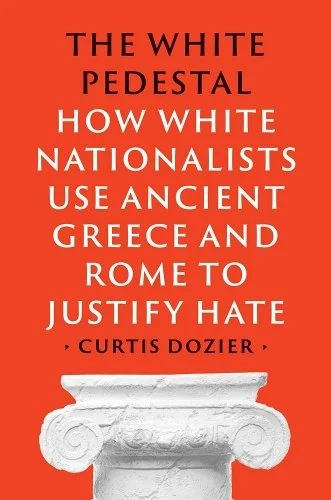
Book Review: The White Pedestal: How White Nationalists Use Ancient Greece and Rome to Justify Hate
Curtis Dozier’s impressive debut provides an encouraging and distressing analysis of how the far right weaponises ancient history. A detailed and timely study, the book clearly shows that the elite status of Classics causes – and has for centuries – far more harm than simple snobbery.
The book identifies two primary objectives behind the right-wing appropriation of ancient cultures: first, to suggest that white supremacist (WS) ideologies can be anchored in rigorous, respectable foundations; and second, to paint a veneer of elite educational status and perceived legitimacy on those who claim connections between the classical world and their racist attitudes. Along the way, Dozier traces the origins of these associations and dismantles the historical errors upon which they rely.
Dozier’s research introduces the reader to a ghoulish cast of protagonists in the WS movement, though he is at pains to focus on high-profile figures operating in academia and positions of high public profile, instead of the lower-hanging fruit of online clickbait accounts. The result is a lean and punchy methodology that elevates the book, and allows Dozier – and the reader – not to get lost in the weeds. What quickly becomes clear is that the reach of WS goes far beyond a few fringe academics publishing niche articles in obscure journals. The figures Dozier takes to task are often academics with the certificates to give their opinions heft in the public sphere.
The difficulty arises when, for example, the racist tropes about Sparta which hypnotise those obsessed with the 300 are also revered by serious scholars, and their works reflect this, further embedding these not-so-innocent ideas in the public consciousness without proper examination. Presentations like this allow these ideas to be entertained at a more serious level. As Dozier notes, Zac Snyder’s film 300 was an enormous influence on the general population’s understanding of Sparta, but the ideas underpinning it – the decadent Persians, the whiteness of the Greeks, and the “last stand” of one civilization against another – had all been employed by white nationalists going back to the nineteenth century.
Dozier highlights how WS ennobles violence and xenophobia, noting that “Contemporary portrayals of masculinity often link strength and honour with physical aggression and violence.” He cites Hitler’s Mein Kampf, in which Greece is recalled as ‘a culture that is fighting for its existence.’ This perennial notion of a society under attack is used to legitimise the targeting of non-whites and non-Western cultures. “They allow,” Dozier explains, “violent terrorists to view themselves as noble defenders of civilization.” He also points to the WS use of Odysseus’s slaughter of the suitors as a metaphor for ethnic cleansing, used to justify driving out “invaders” and re-establishing patriarchal control.
The White Pedestal explores how these ideologies manifest in modern discourse from the “Great Replacement” theory to the riots at the Capitol, to the crimes of Ancient Apocalypse, to Aristotle and Enoch Powell… There’s a lot to bite into. For instance, Dozier spends a couple of paragraphs looking at the intense backlash against Netflix for casting Adele James as Cleopatra in 2023. Almost uniformly, the criticism of this decision professed to be based on "historical inaccuracy"; yet the same people were comfortable allowing "creative license" when Brad Pitt (aged forty) played an Achilles in his twenties. As Dozier observes: “It is only skin colour that provokes controversy because only skin colour has been embedded in an implicit hierarchy of races.”
However, Dozier’s criticism is even-handed, and does not shy away from the reality that many ancient texts are themselves steeped in prejudice. While the Greeks and Romans categorised and ranked human beings – and prejudice against non-Greeks, non-Romans, and enslaved people is easily found – these hierarchies were not based on modern notions of race. Dozier argues that the perception that race is a stable and consistent concept throughout history is the cornerstone of white supremacist classicism, and that we have a duty to dismiss this error when we encounter it:
“Highlighting differences between ancient and modern attitudes toward Blackness significantly undermines white nationalist racial ideology, which requires that concepts of race be stable throughout history. Such differences demonstrate that these concepts change to suit the desire of the politically powerful to divide human beings into categories that justify the unequal distribution of resources. It’s a historical truth that strikes at the heart of white nationalist ways of thinking about the ancient world, and about race itself.”
By examining figures such as the American founding fathers (whose attitudes to slavery were influenced by rigid hierarchies of human value derived from the ancient world) and analysing key WS Classical texts from previous centuries, Dozier holds a light over their espoused connections between Rome, Athens and the modern United States. He argues that much of this ideological garbage is obscured by the "elite" status afforded Classics in so many countries. People are hesitant to criticise them because they are Classicists, and Classics is just for super smart folks, right?
The writer’s clarity in seeing the pipeline from Rome to the antebellum United States to the events in Charlottesville in 2017 makes it inarguable that, at best, poor historical analysis has been employed by WS writers which has led to the use of the history of the ancient world to justify racial violence in the modern. It is a remarkable combination of cool research and crisp prose which absolutely zips along.
Because the study of the ancient world is so associated with high-brow intellectualism, white supremacists trying to strengthen weak arguments and add substance to insubstantial positions turn to ancient sources. This elitist perception gives the discipline power for those who want to proclaim their erudition – a power that is the direct result of centuries of silencing contrary voices. As long as Classics remains "paywalled" by elite private institutions and marginalised in state education, it is perhaps inevitable the subject has become synonymous with privilege.
Ultimately, The White Pedestal reflects the fact that the disciplines which investigate the ancient world have often gone unchallenged in their tolerance of racist hucksters and charlatans. It is remarkable that so much evidence – supplemented by 70 pages of detailed notes – has been corralled into just 170 very readable pages. Every one of them hammers the use of bad research by white nationalists to support a racist agenda. But the criticism is nuanced, and encourages the reader to understand that there existed xenophobia and racism in the ancient world, and we would do well not to hide that fact, but nor should we be blind to how contemporary prejudices can become part of a constantly evolving view of the ancient world.
The White Pedestal is marvelously readable, and Dozier unfolds his arguments with elegance and wit, providing apt examples and counterpoints throughout. It may not be the kind of content you’d describe as pleasant, but the book is vital. It tackles a core issue in the discipline and articulates how to push back against racism in academia, and we can all use that kind of hope.
We have one copy of The White Pedestal: How White Nationalists Use Ancient Greece and Rome to Justify Hate to give away.
To get your name in the draw (UK only):
Head to this post on our Bluesky account, repost it, comment “win”, and give us a follow.
We’ll choose a winner on 1st May 2026 at 10am. Good luck!