

The One Time Cicero Didn't Talk Enough
Cicero liked to talk. He's infamous for it, and many are the Classics students who lose their will to live waiting for Cicero to get to the verb in each of his lengthy sentences. Most ancient historians give him a pass, though, because even though he's loquacious (and, let's face it, irritating), he tells us so much about the late Republic of Rome that we just don't get from any other source. And so, we tolerate Cicero's prolonged prose. So what happens when Cicero, for once in his life, doesn't say enough?
I am the unfortunate ancient historian having to currently deal with this dilemma. Allow me to explain (and in a little more detail than I could fit into the book!)
For the last half decade at least, I have been struggling to answer questions about Roman gladiators seeping into the Greek world, and the evidence I've craved sometimes has been lost forever to the mists of time. On other occasions, it's been swept underneath academic rugs, either in an attempt to preserve a fictitious image of a sophisticated, genteel ancient Greece, or left to gather dust, barely published, in a museum storage depot. And sometimes, I've found nuggets of tantalising gold, sprinkled in the most unlikely of places. This article is about one of those teeny, tiny nuggets, and how finding a clue like this can actually make my job a lot more difficult.
In 50 BCE, Cicero was in western Asia, acting as proconsular governor of Cilicia. We have quite a lot of information about his time there, as Cicero (like many elite Romans) kept up a regular and frequent correspondence with many of his contemporaries. Unlike them, Cicero made sure to have his letters published for posterity. One of his most frequent and beloved pen-pals was Titus Pomponius Atticus, a very wealthy Roman and big fan of Greek culture. Cicero wrote to Atticus from Cilicia, and we have some of those letters. The one I'm interested in specifically, Letters to Atticus 6.3, is a letter full of musings on political developments, administrative bits and bobs Cicero is dealing with, and his favourite epistolary pastime: gossip. We even know roughly when it was written and where it was sent from - Cicero was writing en route from Laodikeia to Tarsus and sent Atticus this letter in late May or early June.
The piece of gossip that caught my attention was this:
"Another thing I may as well mention is that Hortensius junior was in Laodicea for the gladiators, behaving in a scandalous, disgraceful fashion. For his father’s sake I asked him to dine the day he arrived and equally for his father’s sake did nothing more. He told me he would wait for me in Athens in order to go back with me to Rome. ‘Very good’ I said. What else could I say? To be sure I don’t suppose that what he said meant anything. I hope not, for I shouldn’t like to offend his father, for whom, believe me, I have a great regard. If however he does accompany me, I shall handle it so as not to give offence where I least wish." (trans. Shackleton Bailey)
For Cicero, the main thrust is that he's bumped into the errant son of a mutual acquaintance who is far from home and, by all accounts, acting with all the decorum of an English kid going on a mad lad's Jet2 holiday to Magaluf. Cicero is only interested in the boy's behaviour, and not the wider circumstances of their chance meeting. So this, for me, is a frustratingly vague throwaway comment that prompts more questions than it offers answers, even if we read behind the lines.
Firstly, Cicero doesn't raise an eyebrow about there being gladiatorial combats staged in Laodikea, despite this being only the second literary reference to Romans staging combats in Asia Minor (the first being Lucullus only two decades previously, in Ephesus). This nonchalance is interesting. Does it suggest that only twenty years later, gladiators aren't a novelty in Anatolia anymore?
Cicero also doesn't bother telling us who is hosting the games. As governor of Cilicia, one might expect Cicero himself to be responsible as Laodikea falls under his jurisdiction at this point, and he's frequently there to oversee legal proceedings. As a member of the Roman elite and in a position of power, would provincial governors take on the task? However, if he was going to the trouble of sourcing a gladiatorial troupe on even a semi-regular basis, we might expect him to have mentioned that in other letters. We know that later, it will fall to the High Priest of the Imperial Cult to bear the responsibility of putting on gladiatorial games, but the Imperial Cult doesn't exist at this point. Perhaps it was a local magistrate? We will never know, because Cicero doesn't bother telling us. Boo.
What kind of show was it? We're not told if this was a smaller, 'boutique' show for resident Roman citizens, or a larger show staged for the whole city to enjoy. It doesn't seem to have been related to an elite funeral as gladiatorial games had exclusively been until very recently; Julius Caesar had opened the floodgates to that fifteen years before when he'd hosted 'funeral' games for his father who had been dead for twenty years, and very quickly Romans realised that a dead person wasn't actually a necessity to have gladiators perform (unless the dead person was one of the gladiators themselves).
We only have two recorded instances of gladiators fighting the Greek world before this: a Seleukid king, Antiochus IV, had presented gladiators to locals as part of a triumphal parade and festival near Antioch in 166 BCE, beating Romans to the punch by almost a century. The Roman general Lucullus had done the same in Ephesus in 70 BCE, with athletes to please the locals and gladiators to please his own, homesick legions. The audience for the Laodikeia games is a bit more difficult to determine. As for the gladiators themselves, we have little clue. We're told Antiochus had started to train up his own rather than import expensive gladiators trained on the Italian peninsula, and we have no information on where Lucullus got his hands on gladiators in Ephesus. We do know that by two decades after the Laodikeia games, Mark Antony had installed his own gladiatorial ludus in Cyzicus, which given Antony's extended presence in the eastern Mediterranean made complete sense from a logistical point of view. Were the gladiators at Laodikeia local? Imported? We simply aren't told.
Where was the show held? Laodikeia has no amphitheatre, nowhere in Greece or western Asia had one of those yet. In fact, when we nail down a date for this sojourn in Laodikeia, which was 50 BCE, the only permanent amphitheatre in the entire world was only then being inaugurated twenty years before in Pompeii. Rome certainly didn't have one yet. Would the citizens of Laodikeia be rushing to build a very new type of structure only just becoming fashionable in Italy? As I've learned, Greeks didn't really need expensive amphitheatres when they already had perfectly good alternative venues. In Rome at this point, fights were fought in the Forum Romanum, where temporary wooden bleachers could easily be knocked up within a week. The Greek equivalent of the forum was the agora, and if you walk around Laodikeia today (which is highly recommended - go before it turns into a mega-crowded Ephesus 2.0!) you'll find a couple to choose from. But in 50 BCE, Laodikeia wasn't quite as grand as the ruins suggest. The North 'Sacred' Agora hadn't been built yet, as Laodikeia would eventually be getting various monumental upgrades under Augustus, who at this point was only 13 years old. Neither had the South Agora, built to honour the Emperor Hadrian when he visited the city in 129 CE. The Central Agora was monumentalised by Rome in the 2nd century CE, and it's unclear how old the earlier agora beneath it was. The Western Agora is hard to date as it's less excavated than the others, but does have inscriptions that date additions and restorations to Septimius Severus, and the Eastern Agora is similarly difficult to nail down. So our five options are narrowed down to three questionable possibilities.
My research has shown me that Greeks developed a sophisticated and subtle group of options to make their already ancient theatres and stadiums safe for gladiatorial shows - raising the front rows of seats away from the orchestra ('dancing place') or dromos (running track) with a podium wall prevented stray blades harming spectators, or perhaps a masonry or orthostate parapet wall if the height of the front row was to stay the same. If all else failed, wooden or metal barriers (much like the ones we use today for big crowd events) were cheap, temporary and easy to add. These were all unobtrusive and affordable changes that didn't interfere with the venue's original functions too much, and were very popular. Should we look there?
Let's start with the stadium. When I visited in September '25, I saw the very beginnings of intensive excavations starting in that area, and earlier photos and archaeological reports don't give much indication of whether they'll find the trademark podium safety wall. The stadium is enclosed at each narrow end by a semicircle of seats, we call these the sphendonai. These enclosed ends were typically added to older stadiums by the Romans when they switched grassy banks or benches for stone rows of seats. That's a good indication of contact sports being performed here, like pankration, and was also a popular location for gladiatorial games. In stadiums like Perge, Messene, Ephesus and Aphrodisias, a sphendone has been permanently walled off from the straight running track, sometimes even shortening the track itself, to create an oval arena, but wooden bleachers or fencing could temporarily do the same thing for cities that didn't want to alter their stadium too much. Laodicea stadium is large, the biggest in Anatolia even, and a logical place to host Roman spectacle, which it absolutely did. Greek gladiators loved performing in stadiums, nicknaming them the Stadia of Ares after the god of warfare. My issue is, the stadium did not exist when Cicero visited. It wasn't built until the reign of Vespasian, over a century later, in 79 CE (the same year Pompeii was destroyed.) I'm eagerly awaiting the results of this latest excavation, but it can only tell me about imperial Greek gladiators, not Cicero's.
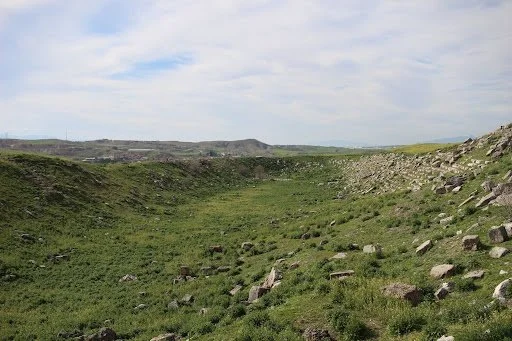
Stadium, wikimedia Blcksprt, CC BY-SA 4.0 <https://creativecommons.org/licenses/by-sa/4.0>, via Wikimedia Commons
What about theatres? Laodicea has two theatres. The Greek world has hundreds of ancient theatres, and at least 20% have these architectural adaptations in place, surely we can see one at Laodicea?
The North Theatre is interesting to visit, in that it remains half buried with only the lips of seating rows emerging from the grass. It looks more like someone has taken a scoop out of the hill with a giant spoon than the cleaned, restored theatres we're used to at other sites. Nevertheless, it seems that small excavations have confirmed that the orchestra was turned into an arena by raising the front rows. Further excavations wouldn't matter though, because again, the North Theatre was not there in 50 BCE, it was built in the 2nd century CE.
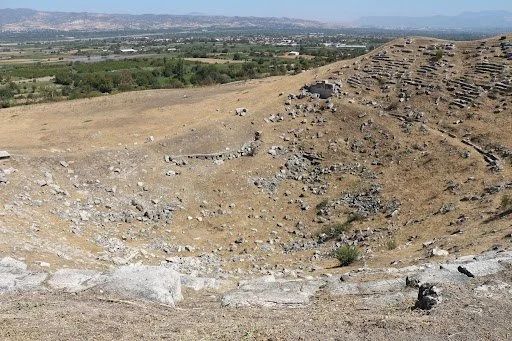
The North Theatre; author’s own image
A short walk away is the West Theatre, and that did exist, as it was Hellenistic and not Roman. This is the theatre you've probably seen the dramatic before-and-after excavation photos of on social media, because the Turkish archaeologists have recently spent a lot of time and effort taking this theatre from a grassy scoop of hillside into a beautiful theatre that might have been made yesterday. This is a theatre Cicero could have sat in, but would he recognise it?
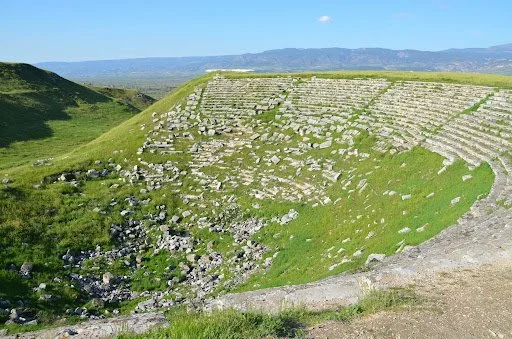
West Theatre pre-excavation; image by Carole Raddato
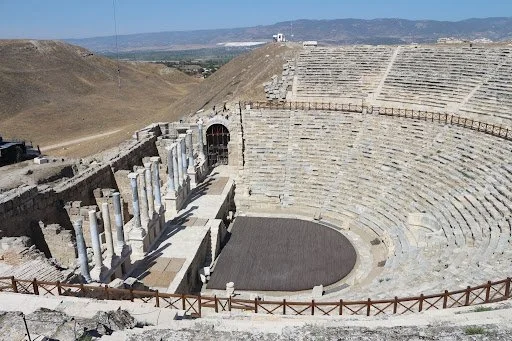
West Theatre, post-excavation; image by the author
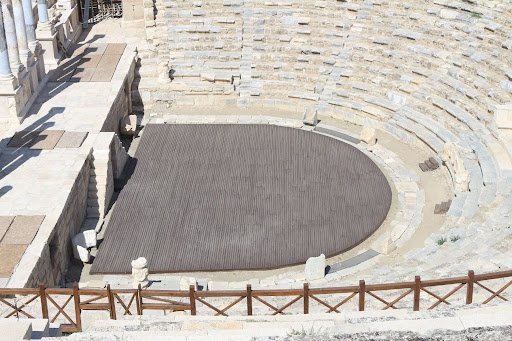
West Theatre, close-up of the orchestra, showing the alteration
To begin with, the theatre would have been half the size, seating wise, as the cavea (seating area) was vastly expanded long after Cicero visited. As for the performance space, we can clearly see where the front two rows of seating have been removed, widening the orchestra/arena space and lifting the audience above the floor. This is typical, and we see it in dozens of theatres. The problem is twofold:
Firstly, the first securely dateable permanent theatre alteration is from Nero's reign, in the Theatre of Dionysus. This theatre having an alteration so much earlier isn't plausible.
Secondly, this theatre wasn't touched by Romans until at least Augustus, and we're not sure which phase of Roman alterations this safety feature dates to, so even if this alteration did pre-date Nero, it's not by enough. Will we ever be able to date this change here? I wouldn't be surprised if the archaeologists aren't too interested in answering the question, as all too often, gladiators in Greece are swept under the rug. The tourist sign at the site mentions alterations but slyly neglects to mention why the alterations were made, and the guidebook written by the lead archaeologist merely diplomatically says that the alterations were made so that the theatre could be used for 'different purposes.' And I get it, if you have a sanitised picture of a sophisticated Greek theatre populated with lovey thespians and elegant drama-lovers there to catch the latest revival of Sophocles, gladiators spilling blood in the same space does tarnish the utopian, tranquil image somewhat. And the archaeologists at Laodicea are by far not the only ones to sidestep the question of gladiatorial presence in the cities they're excavating, this was a roadblock I had to climb over multiple times. I just think that it's needless curation and obfuscation of the past, to give a partial report of the evidence. Hey ho.
So we have multiple agoras that didn't exist yet, a theatre and stadium that didn't exist yet, and an older theatre that had no permanent safety alterations yet, when Cicero was in town. Laodicea in 50 BCE was not the city it became, it was greatly damaged in the Mithridatic Wars a few decades before Cicero visited, and hadn't yet seen the investment and revitalisation that would not only see it recover, but grow to be a major player in Roman Anatolia. If anything, that fact makes it all the more stupendous that this is only the third recorded locale for gladiator games in the Greek world! So if I'm in Laodicea in the 50s, I want to present gladiators but I have a limited budget, I'm thinking that the a few wooden or rope barriers around the West Theatre is going to be quicker and easier than building of raked wooden bleachers around one of the Hellenistic agoras, and the view for spectators will be better too. Therefore, I'm going to give an educated guess and suggest Cicero saw Hortensius Jnr in the West Theatre, even if Cicero can't confirm.
For what it's worth, the fourth and fifth mentions of gladiators in the Greek world are courtesy of Julius Caesar who built amphitheatres in Corinth and Antioch a few years before his assassination, and the sixth is Mark Antony's aforementioned private troupe of fighters in Cyzicus who he was apparently saving for the victory celebrations over Octavian in the 30s (which, spoiler alert, didn't occur, and Cassius Dio tells us that after his disastrous defeat at the Battle of Actium in 31, Antony's gladiators broke free from the ludus and tried to travel to Egypt to fight for him, before being apprehended in Antioch. Again, a small throwaway comment, with wider implications and a hint at the extraordinary loyalty Antony could muster).
Antiochus, Lucullus, Caesar, Antony. All men who incorporated Roman gladiators into their military campaigns, victory celebrations, and into entertainment for their troops and veterans. That's not the case in Laodikeia.
When Cicero writes to Atticus, he mentions that he's concerned that war in Syria might spill over into Cilicia, the province in which Laodikeia was briefly part of at this time. And then he says, he has no legions stationed there, he has no defences. So the games aren't part of a victory celebration, and there are no soldiers present who watch the gladiators for a taste of home. There are clearly quite a few Romans present, not just in Cicero's retinue of staff and administrators, but the sons of elite Romans on some kind of gap year holiday. The city had nowhere near the number of Roman immigrants that it would see in the imperial period, so the intended audience for these games that, even if modest in size, would still be quite a pricey event to produce. Perhaps the Laodikeians, culturally Greek from their Seleukid founding, were already recognising the potential of Greekness (athleticism, competition, and the literary and mythological love of duels) in this very Roman import.
And so - Cicero provides a date to add to my timeline, but he forces me to ask more questions than he's willing to answer. In other words, he's muddied the picture even more than it was before I read this letter. There aren't many ancient historians who can legitimately complain that Cicero didn't provide them with a tonne of helpful information, but I regretfully join their club. The initial spread of gladiators into the eastern Mediterranean may be full of problems like this one, but fast forward a century and the picture becomes much clearer. To see it, you'll have to read the book!